Electrifying Africa’s Minibuses: What the DigitalTransport4Africa Data Reveals

4th Paratransit / Popular Transport Day : A side event of Transforming Transportation 2026
13 February 2026
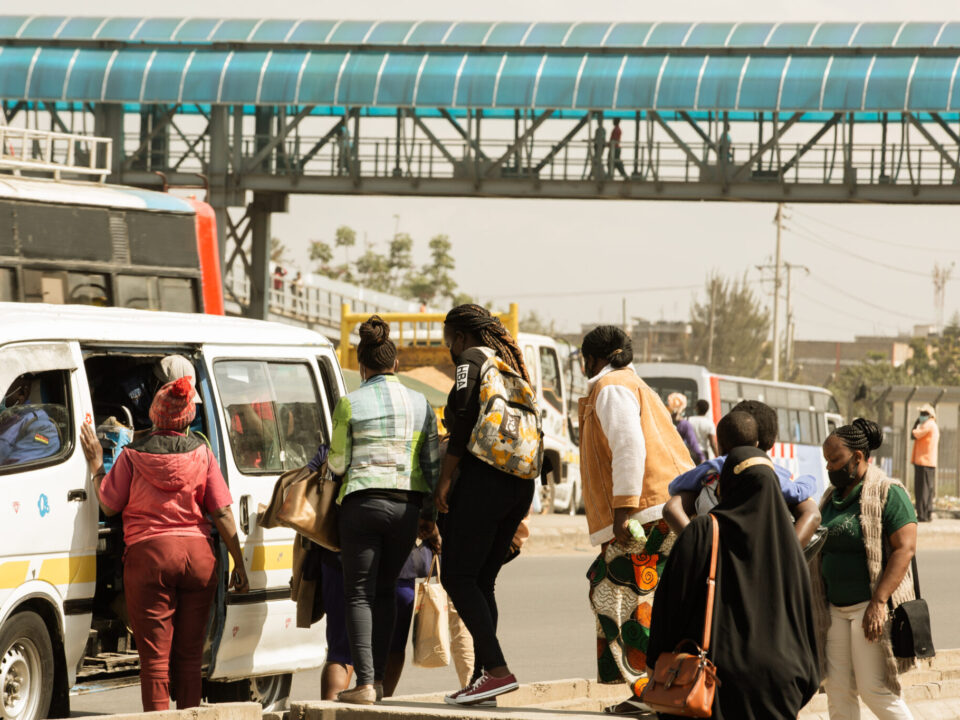
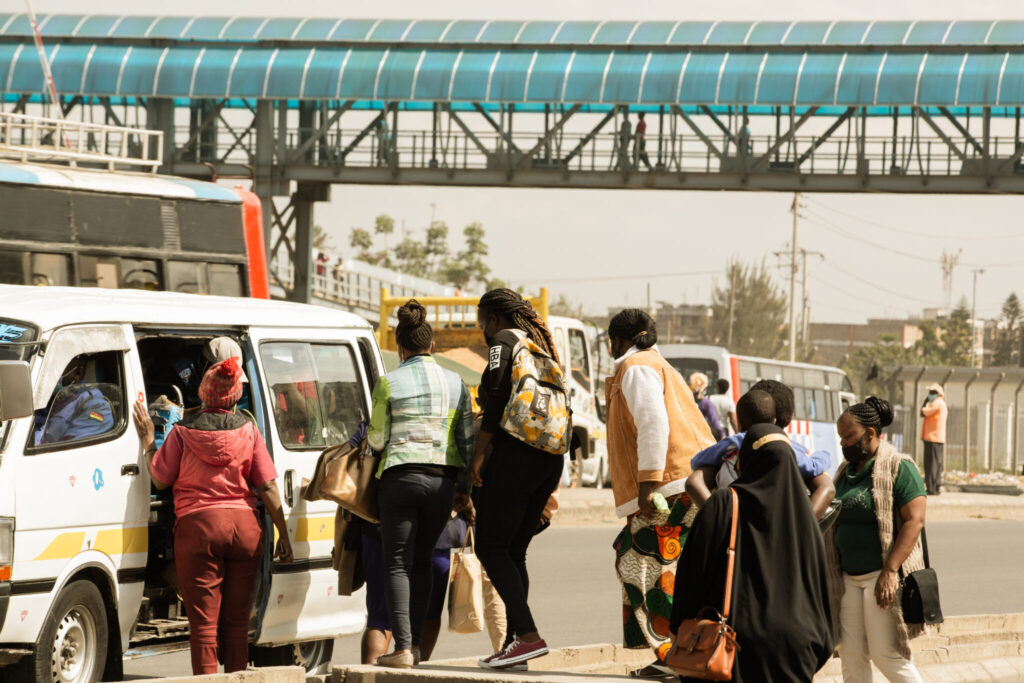
Minibus in Addis Ababa. Photo courtesy of Agraw Ali/WRI
What would happen if Africa’s iconic minibuses went electric?
Every day, millions of people across African cities rely on minibuses for their daily mobility needs. These include matatus in Kenya, tro-tros in Ghana, and many other forms of shared small buses. While not always the most comfortable transport option, they play an important role in filling the mobility gaps left by formal transport systems, offering a flexible, fast, and remarkably efficient service that is likely to remain central to urban mobility for years to come.
But this comes with a cost. Most of these minibuses are ageing diesel models, often imported second-hand. They are noisy, polluting, and contribute to a dependence on costly fuel imports and subsidies. This dependence also creates vulnerability to global fuel price shocks, as highlighted by recent geopolitical tensions affecting fuel supply chains.
At the same time, electric mobility is gaining momentum across Africa. Pilot projects are emerging, and governments are introducing electric mobility policies.
So, what if these minibuses went electric?
That question is at the heart of GTFS4EV, a new open-source modelling tool developed within the OpenMod4Africa project to help explore the impacts of public transport electrification and identify optimal electrification pathways. Built around General Transit Feed Specification (GTFS) data, the model estimates charging demand, environmental impacts, operating costs, and the technical feasibility of electric minibus deployment under real operating conditions.
In a recent study published in Scientific Reports, “Energy, environment, and economy implications of electrifying minibus taxis in African cities”, Jérémy Dumoulin and co-author from EPFL used GTFS4EV together with DigitalTransport4Africa (DT4A) data to analyze what electrifying minibus fleets could mean for nine African cities (Figure 1). The result reveal enormous potential…but also show clearly that there is no one-size-fits-all solution for deploying electric minibuses across African cities.
The importance of planning ahead
This becomes clear when looking at simulated charging demand across cities in our study.
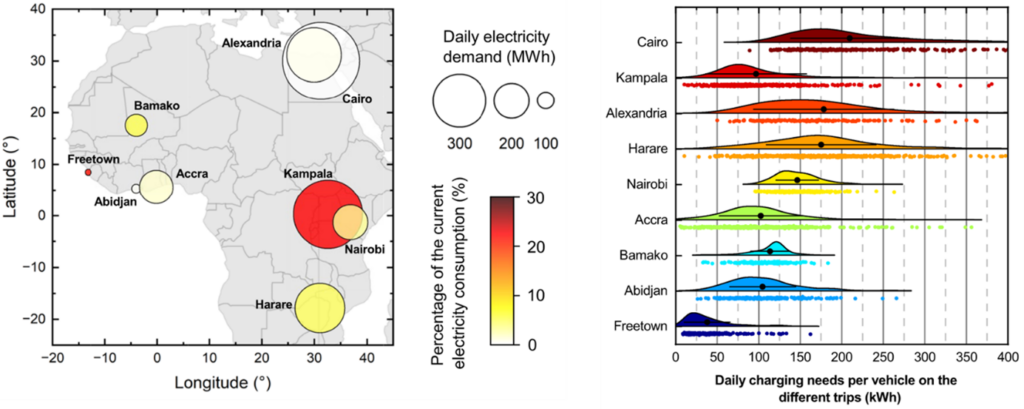
Figure 1. Total daily charging demand for the nine cities and distribution of the charging needs per minibus taxi
In some places, electrification would add only a tiny amount of extra demand. In Cairo or Alexandria, minibus charging would increase the current city’s electricity consumption by less than 1%. In other cities, the impact would be much larger. In Kampala and Freetown, electrifying minibuses could increase electricity demand by more than 20%. That does not mean electrification is impossible there. But it does mean planning becomes critical.
We also found large differences in how much energy each vehicle would need every day. In Freetown, the electric minibus would require less than 40 kilowatt-hours on average, while in Cairo it could require more than 200 kilowatt-hours because of profound differences in travel patterns.
Cities with shorter trips and fewer daily charging needs may be able to adopt affordable electric minibuses with smaller batteries immediately, charging once a day at the depot. Other cities may require larger batteries, more frequent daily charging and fast-charging facilities.
Overall, the findings point toward a clear conclusion: there is no universal strategy for electrifying minibus fleets across cities. Planners will need to carefully analyze local mobility patterns and infrastructure constraints to design viable electrification pathways.
Cleaner air and lower carbon emissions
One of the clearest benefits of electrification is cleaner air. We estimated that around 23 million people across the nine studied cities live within 300 meters of minibus routes and are regularly exposed to traffic-related air pollution from diesel vehicles.
Interestingly, some of the highest air pollution exposure areas were not always located in city centers. In Abidjan, for example, densely populated outer districts also showed high exposure levels. That means electrification could improve health outcomes not only downtown, but across entire urban regions.
Depending on the city, electrifying a single minibus could also prevent between 4 and 19 tons of CO₂ emissions every year. Of course, these benefits need to go hand in hand with renewable electricity development. Cities with cleaner electricity grids, such as Nairobi and Kampala, showed the highest reductions.
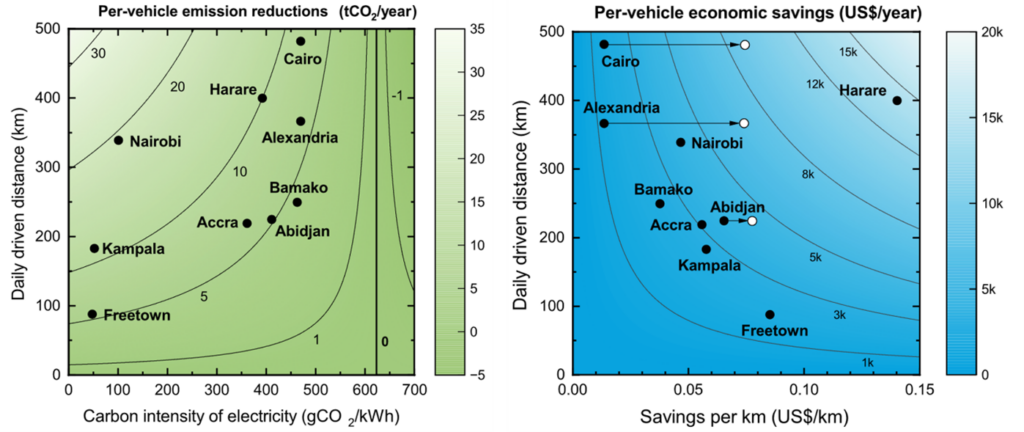
Figure 2: Yearly per-vehicle CO₂ savings (left) and cost savings (right) across the studies cities.
Could electric minibuses also save drivers money?
For many drivers and owner-operators, the most important question is not carbon emissions but economics. Here too, the results of our study are very encouraging: electric minibuses were cheaper to operate in every studied city because electricity costs less than diesel per kilometer travelled. Depending on the city, annual fuel savings ranged from about US$1,000 in Alexandria up to US$14,000 per vehicle in Harare.
These savings could help offset the higher upfront cost of electric vehicles over time. However, policy choices play a crucial role in shaping these outcomes. In several countries, diesel fuel is currently subsidized. Removing those subsidies could make electric mobility even more financially attractive while freeing public funds.
Conclusion
Our study shows that massive electrification will require city-specific strategies. Some cities may need to reinforce electricity grids or invest in additional renewable energy capacity. Others may need to think deeply about charging strategies or even reschedule parts of their fleets. Many cities will likely need everything.
Data and planning frameworks are essential to tackle this complexity, helping to anticipate challenges before they become bottlenecks and identify feasible and cost-effective deployment pathways.
The good news is that African cities do not have to start from scratch. Open transport data and open-source modelling tools now exist, supported by initiatives such as OpenMod4Africa (i.e. the GTFS4EV model) and DT4A.
The real challenge now is ensuring that these resources reach the stakeholders shaping urban transport in practice. That they use them, build on them, and make them their own. The tools exist. The data exists. Now we need people to turn insights into action.